Quick Answer: What to Do Right Now
Shut off the water at the fixture stop valve under the sink or behind the appliance. If the stop is stuck, close the main shutoff. Unplug any wet appliance from a dry outlet. Pull standing water off hard floors with towels, then call a restoration team within the first 24 hours to prevent Category 1 water from degrading into Category 2 and mold conditions setting in around hour 48.
Common Kitchen Leak Sources in Smokey Row Homes
Sink and Plumbing Failures
- Braided supply line burst at the angle stop (most common after 8 to 10 years)
- P-trap separation or slip-nut leak under the basin
- Garbage disposal flange or housing crack
- Faucet base seal failure dripping behind the cabinet
- Reverse osmosis or instant-hot tank leak
- Pull-down sprayer hose splitting at the quick-connect
- Dishwasher air gap overflow during a clogged discharge cycle
Appliance Failures
- Dishwasher door gasket, pump seal, or supply hose
- Refrigerator ice maker line (1/4 inch poly tubing splits at the saddle valve)
- Built-in coffee or steam oven water line
- Range hood condensate drip in humid months
- Water softener bypass loop terminating near the kitchen wall
The single most overlooked source in Smokey Row kitchens is the saddle valve behind the refrigerator. These piercing valves were installed by the thousands in the 1990s and early 2000s, and the rubber gasket inside fails quietly. Homeowners often discover the leak only when hardwood in the adjacent dining room starts to cup, weeks after the drip began.
What Smokey Row Water Restoration Does on a Kitchen Loss
- Arrive within 60 to 90 minutes for Smokey Row emergency calls
- Stop the source or coordinate with a licensed plumber
- Extract standing water and remove base cabinet toe-kicks for airflow
- Set air movers and LGR dehumidifiers sized to the affected cubic footage
- Monitor daily with moisture logs your adjuster can verify
- Coordinate cabinet, flooring, and drywall rebuild or refer trusted trades
IICRC Water Categories in a Kitchen Setting
Not all kitchen water is the same. The category drives whether materials can be dried, sanitized, or must be removed. This is the framework insurance adjusters use, and it is the framework our techs document on every job.
| Category | Source Example | Action |
|---|---|---|
| Cat 1 (Clean) | Supply line, ice maker line, fridge water line | Dry in place if caught within 24 to 48 hours |
| Cat 2 (Grey) | Dishwasher discharge, disposal backup, aged sink leak | Sanitize, often remove porous materials |
| Cat 3 (Black) | Sewer backup through kitchen drain, long-standing contamination | Remove drywall, cabinets, flooring per S500 |
A clean supply leak that sat for five days is no longer Cat 1. Time and contact with building materials degrade water quality, which is one reason we push for same-day response. For a deeper read on contamination thresholds, see our overview of Category 2 grey water cleanup.
Save or Replace: Cabinets and Floors
- Solid wood cabinets often dry successfully if caught early
- Particleboard or MDF cabinet boxes swell permanently and usually need replacement
- Engineered hardwood rarely recovers once cupped
- Luxury vinyl plank can sometimes be lifted, dried, and reinstalled
- Tile typically stays if the subfloor beneath is sound
The deciding factor on cabinets is usually the toe-kick and the back panel, not the doors. We pull the toe-kick within the first hour, drill weep holes into the floor of the sink base if needed, and push warm dry air directly into the cavity. Saved correctly, a Smokey Row kitchen with $18,000 in custom cabinetry avoids a full tear-out.
Smokey Row Cost Ranges for Kitchen Water Damage
| Scope | Typical Range | Notes |
|---|---|---|
| Small sink leak, dry in place | $750 to $1,800 | Extraction, 3 to 4 days of drying |
| Dishwasher leak with subfloor damage | $2,500 to $6,000 | Cabinet removal, subfloor cut-out |
| Ice maker line, kitchen plus basement ceiling | $4,000 to $9,500 | Two-level drying, drywall removal |
| Cat 3 backup through kitchen drain | $6,000 to $15,000+ | Demo per IICRC S500, sanitization |
Most homeowners insurance policies in Indiana cover sudden and accidental kitchen leaks. Gradual leaks that went unnoticed for months are typically denied. We document the loss start time, photograph source failure, and write the scope in language adjusters recognize.
The Damage You Cannot See
Surface water is the easy part. Kitchens hide moisture in five zones:
- Cabinet toe-kick cavity water pools here and wicks up the cabinet sides
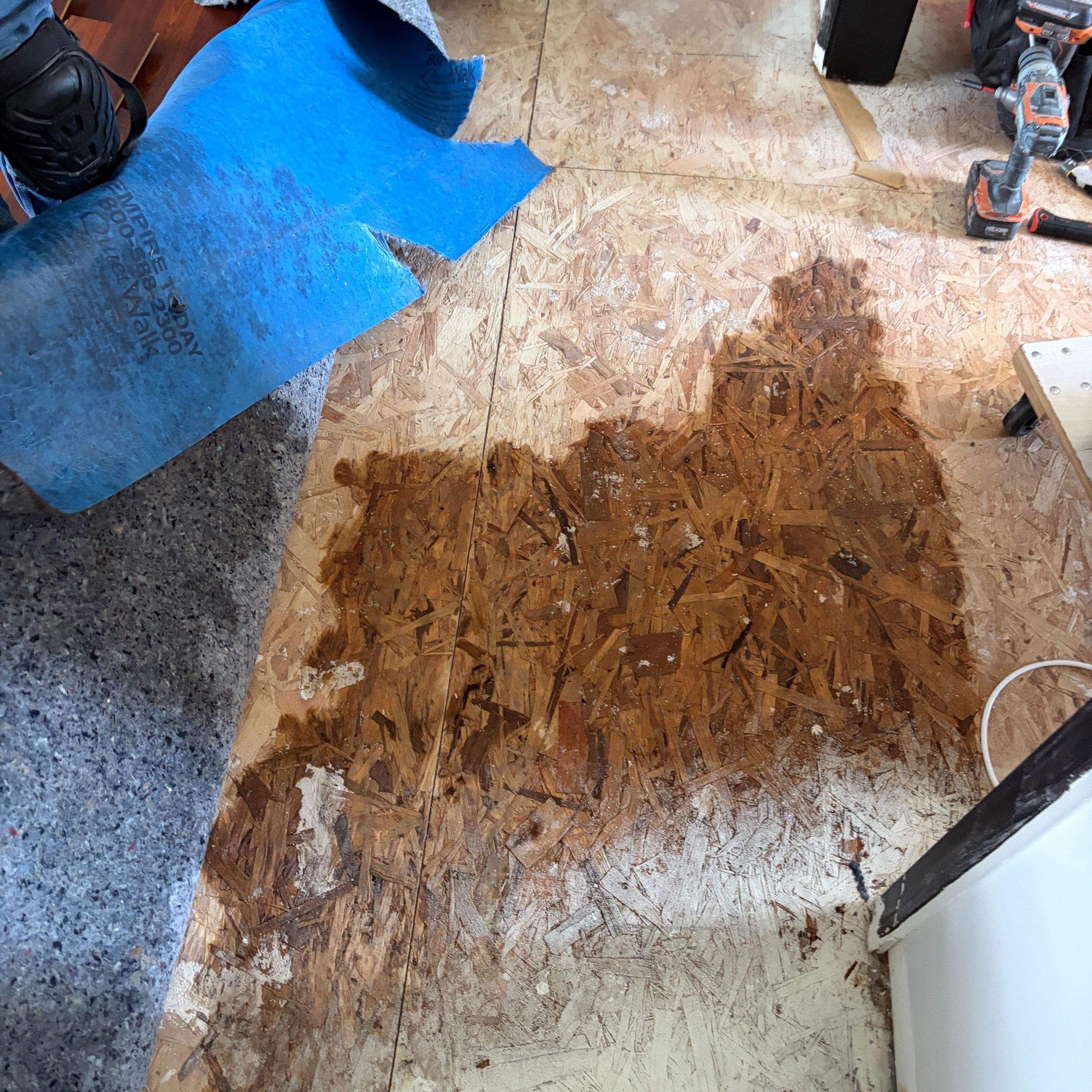
- Subfloor under the dishwasher particleboard or OSB swells and loses structural integrity
- Joist bay below water drips through subfloor seams into the basement or crawl space ceiling
- Drywall behind the sink base moisture migrates up the wall cavity
- Flooring transitions water wicks under vinyl plank, tile grout lines, and hardwood seams
We use thermal imaging and pin-type moisture meters to map all five. If your kitchen sits above a finished basement, you may also need ceiling water damage restoration on the level below. A typical scan takes 20 to 30 minutes and gives us a moisture map that drives the drying plan and the insurance scope simultaneously.
Preventing the Next Kitchen Leak
Annual 10-Minute Checks
- Open the sink base and feel the supply lines for any dampness or mineral crust
- Pull the refrigerator out and inspect the ice maker line for kinks or green corrosion at the connection
- Run the dishwasher empty and check the door seal and floor in front of the toe-kick
- Replace braided stainless supply lines every 8 years regardless of appearance
Smart Upgrades Worth Considering
- Battery-powered leak sensors under the sink and behind the dishwasher (around $20 each)
- Auto-shutoff valve on the refrigerator water line
- Whole-home flow monitor tied to the main shutoff for high-value Smokey Row properties
If you suspect a slow leak that has been running, also review the warning signs in our guide to water damage behind walls. Catching a kitchen leak in the first 24 hours often turns a five-figure insurance claim into a straightforward dry-out, and that is the entire game.